Real vs Fake Moldavite: How to Tell Before You Buy
Updated: Jul 6
If you're looking at Moldavite and wondering whether it's actually real, that's a fair question to ask. There's a lot of fake Moldavite around now. Some of it's obvious. Some of it's sold with a convincing story. Some of it looks close enough to fool people who are buying their first piece.
This guide explains how to tell real vs fake Moldavite without relying on guesswork, hype or a certificate alone. It covers what genuine pieces look like, the one feature that can't be faked, what the newer fakes actually are, and how to buy with more confidence.
If you're trying to work out how to tell if Moldavite is real, start with the piece itself. Good photos, natural surface texture, inner structure and honest seller details usually tell you more than a certificate on its own.
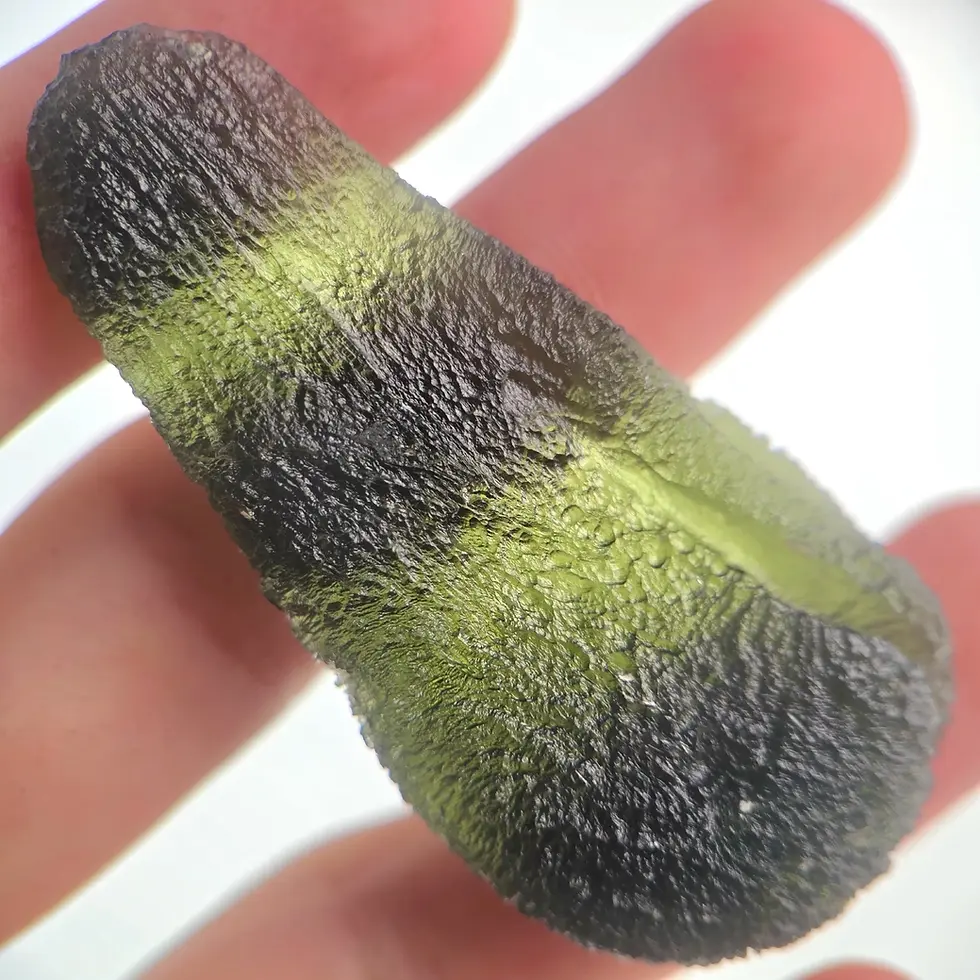
Moldavite is what's called a splash form tektite. That means it formed as molten droplets that spun and stretched in flight, then cooled into the shapes we see today. It doesn't show the ablation marks you find on some other tektites that re-entered the atmosphere, so the grooves, pits and channels on a raw piece aren't from its flight. They come from millions of years of weathering and chemical etching in the ground. That's worth knowing, because it's exactly why genuine Moldavite has such natural, irregular surface character and why fakes that try to copy that texture usually look too even or too deliberate.
That's part of why people feel so drawn to it. There's the scientific side of how it formed, then there's the personal connection people often feel when they hold a genuine piece. Both matter, but authenticity comes first. If the piece isn't real, the story behind it isn't real either.

Quick Moldavite buyer checklist
Before buying Moldavite, ask yourself these questions.
Can I see the exact piece I'm buying?
Is the weight clearly shown?
Are the photos clear and natural?
Does the surface look naturally formed?
Does the shape look individual rather than copied?
Does the colour make sense for Moldavite?
Does the price feel believable for the size and quality?
Does the seller understand what they're selling?
Are they giving useful information, or just creating hype?
You don't need to become an expert overnight. But asking these questions can help you avoid the most obvious mistakes.
Why fake Moldavite is so common
Moldavite has become much more well known over the last few years. More people are searching for it, talking about it and choosing their first piece. When demand rises like that, fake pieces naturally start showing up everywhere.
It's also only found in commercial amounts in one place on Earth, the Czech Republic. Mostly South Bohemia, with some browner material from Moravia. There's a finite amount of it in the ground, the easy deposits are nearly mined out, and prices keep climbing. Rare thing, shrinking supply, rising prices. That's the exact recipe that creates a flood of fakes.
A fake can still be green. A fake can still look interesting in photos. A fake can still come with a certificate. A fake can still be sold by someone who sounds confident. None of that makes it Moldavite.
Some sellers rely on hype because hype distracts people from looking closely. They'll focus on energy claims, rarity, urgency or spiritual promises instead of showing clear photos, exact weights and useful information. Real Moldavite already has enough story behind it. It doesn't need pressure, mystery or exaggerated claims to make it special.
The one feature that can't be faked
If you only remember one thing from this guide, make it this.
Real Moldavite contains tiny threads and blebs of pure silica glass inside it called lechatelierite. Under magnification they show up as fine clear swirls, stretched rounded inclusions, or little wire like shapes that stand out sharply against the rest of the stone.
Here's why they matter so much. Lechatelierite only forms in the instant flash of heat from a meteorite impact. You can't make it in a furnace. So if you can clearly see it inside a piece, you're almost certainly looking at real Moldavite. Fakes don't have it.
There's an honest catch though. Not every genuine piece shows it clearly, especially rough pieces where the surface texture blocks the view, and some Moravian material. So finding it is strong proof a piece is real, but not finding it doesn't automatically mean it's fake. You use this alongside everything else below, never on its own.
This feature is especially useful when you're looking at faceted or polished Moldavite, because the natural outer surface has been removed and you have to rely more on what's inside.

Colour is useful, but not enough by itself
Moldavite is usually green, but the exact tone can vary. It may appear deep forest green, olive green, bottle green, brownish green or lighter green depending on thickness, lighting and the piece itself.
Colour can help, but it’s not enough by itself.
A piece that looks bright artificial green should make you cautious, especially if the surface also looks too smooth or glassy. At the same time, not every darker or brownish piece is fake. Some genuine Moldavite can look darker when it’s thicker or viewed in weaker light.
Colour should always be judged together with texture, shape, internal features, photos, seller transparency and price.

Bubbles don't prove Moldavite is real
This is one of the biggest things people get wrong.
Yes, real Moldavite can contain bubbles. That's true. But bubbles alone don't prove authenticity, because fake glass can contain bubbles too. In fact, a lot of the newer fakes have bubbles added on purpose, specifically to fool people who've done a bit of reading.
So bubbles by themselves prove nothing. What actually matters is the character of the bubbles.
Real Moldavite bubbles tend to be all sorts of different sizes, often stretched or flattened out along the flow of the glass, and scattered in random clusters. Fake bubbles tend to be perfectly round, all roughly the same size, and evenly spaced.
So a clean glassy piece with one or two perfect round bubbles and nothing else going on inside is a warning sign. A piece that looks a bit messy inside, with varied stretched bubbles, swirls and those lechatelierite threads, is much more reassuring.
Bubbles can support the overall picture, but they should never carry the whole decision.
Internal structure and flow lines
Internal features are some of the stronger signs people look for in genuine Moldavite. Real pieces often show fine flow lines and twisted or wispy swirls, sometimes called schlieren, where the molten glass moved and stretched before it cooled. Alongside the lechatelierite covered above, this is some of the best evidence a piece is real.
Hold a piece up to a strong light. Real Moldavite is translucent and a bit busy inside, with that streaky swirling structure frozen into the glass. If the inside is perfectly clean and clear like a glass marble, that's a warning sign.
In raw Moldavite, internal features can be harder to see because the surface texture blocks a clear view. Strong light, water or oil can sometimes make details easier to notice, but you still need to judge the whole piece rather than relying on one feature.
What the fakes actually look like now
The old fakes were easy. Bright green, shiny like a melted bottle, nothing going on inside. Anyone could spot them.
The newer ones are a different story, and this is where people are getting caught.
Moulded furnace glass. Counterfeiters now take moulds straight off real Moldavite pieces, cast green glass into them, then etch the surface with acid or sandblasting to fake that weathered texture. They even add bubbles. The result can look close to a lower quality real stone. What gives them away is the lack of lechatelierite, the same texture repeated across multiple pieces, and faint mould seams or a too even surface under magnification.
Faceted and jewellery fakes. This is the trickiest category. Flawless faceted green "Moldavite" gets churned out and sold with official looking certificates. The rule here is simple. Real faceted Moldavite almost always shows bubbles and usually lechatelierite inside. A flawless, perfectly clear faceted green stone is glass. Faceted pieces are the easiest to fake and the hardest for a beginner to judge, so only buy them from someone you trust.
Fake "Besednice" hedgehogs. Besednice Moldavite, with its deep spiky texture, is the rarest and most prized grade, and that locality is essentially mined out. So it's a common target. Ordinary stones get relabelled as Besednice, and moulded glass "hedgehogs" with suspiciously neat, symmetrical spikes show up online.
Beads and spheres. A round, fully textured "Moldavite" bead is essentially a guaranteed fake. You can't keep that natural sculpted surface on a rounded bead, and making real ones would waste a fortune in material. Cheap textured bead bracelets are fakes.
Resin and plastic. Cheaper still. These feel warm and light in the hand, look a bit cloudy or plasticky, and have no real structure inside.
One more thing to watch for. Invented names like "African Moldavite," "lab created Moldavite" or "synthetic Moldavite" are just green glass. Moldavite only comes from the one region in central Europe. Nowhere else.

Real vs fake Moldavite: the warning signs
There are a few warning signs that should make you pause.
If the piece looks overly smooth, overly glossy or too machine made, be careful. If it looks like green glass that's been shaped to appear natural, be careful. If the seller has many pieces that all look almost identical in shape, colour and texture, that's a red flag.
If the photos are blurry, heavily edited or don't show the exact piece you're buying, that should make you cautious. If the seller only uses stock photos, that's not good enough. If they can't show weight, size or clear details, you're being asked to trust too much.
Price matters too. Expensive doesn't automatically mean genuine, but if a large piece is being sold for a price that seems unbelievably low for its size and quality, there's usually a reason. Real Moldavite is sold by the gram, and the price climbs with weight, colour, clarity, shape and locality. Lower grade or damaged material is genuinely more affordable, which is normal and fine, but a big, clean, deeply sculpted piece going for next to nothing almost never adds up.
The biggest red flag of all is when the listing relies more on hype than transparency.
A quick word on UV light
You might read that you can check Moldavite with a UV torch. Here's the honest version.
Real Moldavite does nothing under UV. It stays dark. A lot of fake glass, on the other hand, glows a chalky white, especially under short wave UV. So if a piece glows, that's a bad sign.
Just don't read it the other way around. Staying dark doesn't guarantee a piece is real, because not every fake glows. And ignore anyone who tells you real Moldavite is supposed to glow under UV. That's simply wrong.
Locality differences matter
Not all genuine Moldavite looks the same.
Different localities can produce different textures, colours, shapes and surface styles. A sharp Besednice piece won't look the same as a smoother worn piece from another area. Some pieces from certain localities can be more sculpted, while others can appear softer, flatter, darker or more rounded.
That's why it's risky to say all real Moldavite must look one exact way.
A genuine piece should make sense for Moldavite overall, but there's still a lot of natural variation. If you're still learning how size, shape, colour and texture affect the feel of a piece, you can read my guide on how to choose your first Moldavite.
Raw, polished and faceted Moldavite
Raw Moldavite keeps the natural outer surface, so you can often judge the texture, shape and weathering more directly.
Polished and faceted Moldavite are different. The surface has been cut or shaped, so you can't judge it the same way you would judge a raw piece. With faceted Moldavite, internal features become more important. This is where lechatelierite, bubbles, flow lines and overall colour can help.
That doesn't mean polished or faceted Moldavite is fake. It just means you need to use a different kind of judgement.
For most buyers, full lab testing isn't realistic. So the practical approach is to buy from someone who gives clear photos, exact weights, honest descriptions and enough information for you to feel confident.
Does real Moldavite have to feel intense?
No.
Some people feel a strong reaction when they hold Moldavite. They may feel heat, tingling, pressure, emotion or a noticeable shift in awareness. Some people feel nothing straight away. Some feel a quieter connection over time.
That doesn't prove whether a piece is real or fake.
Energy is personal. Authenticity is physical.
A genuine piece doesn't need to hit you like lightning to be real. Sometimes the connection is strong straight away. Sometimes it's subtle. Sometimes it simply feels calm, grounding or present.
The first question should always be whether the Moldavite itself is genuine. The personal connection comes after that.
Why seller transparency matters
A trustworthy seller should make it easy for you to understand what you're buying.
You should be able to see the exact piece. You should know the weight. You should know the size where possible. The photos should be clear enough to judge the shape, colour and surface. The description should feel honest, not exaggerated.
Big claims don't mean much if the basics aren't clear.
A seller doesn't need to over explain everything, but they should be able to show what they're selling properly. If they hide behind blurry photos, vague wording or pressure based claims, that's not a good sign.
And don't lean too hard on certificates. Anyone can print one, and fakes regularly ship with official looking certificates. A generic certificate that isn't tied to your specific stone is basically worthless. Trust the seller and the stone itself first, then treat the paper as a nice extra.
At Conscious Creators, each Moldavite piece is photographed individually, weighed clearly and listed as the actual piece being sold. No mystery pieces. No stock photos. No fake urgency. Just genuine Moldavite, tektites and impact glass presented as honestly as possible.
Why authenticity matters
Moldavite already carries a powerful story. It was formed through impact. It's rare. It has natural character. It has a history that people connect with through science, collecting, energy or all three.
That's why fake Moldavite feels so wrong.
It's not just about receiving the wrong product. It's about something ancient and meaningful being copied, watered down and sold as if it carries the same story.
If you're choosing Moldavite, choose something real. Choose something with its own natural character. Choose something that feels right because it's genuinely what it claims to be.
Quick FAQ
Can real Moldavite have bubbles? Yes, often. But so can fakes. Real bubbles are varied in size and often stretched along the flow. Fake bubbles are usually round, even and evenly spaced. Bubbles alone never prove anything.
Does real Moldavite float? No, it sinks. So does ordinary glass. The float test doesn't tell you anything useful.
Is faceted Moldavite always fake? No, but it's the most faked form and the hardest to judge. Real faceted Moldavite almost always has bubbles and usually lechatelierite inside. A flawless, perfectly clear faceted green stone is glass. Only buy faceted from someone you trust.
Can I trust a certificate? Not on its own. They're easy to fake and fakes ship with them all the time. A certificate tied to your specific stone, with a photo, from a reputable seller, is worth something. A generic one isn't. Trust the stone and the seller first.
Why is Moldavite so expensive? It only comes from one small region, the easy deposits are nearly gone, mining is tightly controlled, and demand keeps rising. Classic scarcity.
Does Moldavite glow under UV? No. Real Moldavite stays dark under UV. Many fakes glow chalky white. So glowing is a red flag, not a green light.
About the author
This guide was written by Nathan from Conscious Creators, a New Zealand based store focused on genuine Moldavite, tektites and impact glass. Conscious Creators was built around clear photos, exact weights, honest product descriptions and a grounded approach to choosing pieces by both knowledge and feeling.
Browse genuine Moldavite
If you feel ready to choose a piece, you can view the current Moldavite collection here. Each listing shows the exact piece, exact weight and clear photos so you can choose the one that genuinely feels right.

Comments