How to Choose Your First Moldavite
Updated: Jun 2
Choosing your first Moldavite can feel weirdly hard.
It should be simple. You look through a few pieces, find one you like, then buy it. But usually it doesn’t happen like that. You start seeing tiny pieces, larger pieces, pendants, carvings, dark green pieces, bright green pieces, smooth pieces, spiky pieces and suddenly you’re trying to figure out which one is “right.”
The truth is, there’s no perfect first Moldavite for everyone.
If you’re completely new to Moldavite, the safest first choice is usually a smaller raw piece under 3g or a simple pendant. If you want something with more presence, the 3g to 6g range is a good place to look. If you’re already drawn to larger collector pieces, that’s fine too, but don’t force yourself into a bigger piece just because it seems more impressive.
Bigger doesn’t automatically mean better.
The better question is simple.
Which piece do you keep going back to?
That sounds almost too simple, but with Moldavite it matters. Weight, shape, colour, condition and price all play a part. They should. But the piece that keeps catching your attention is usually worth listening to.
I’ve seen a lot of people overthink their first Moldavite. They compare size, locality, texture, colour and price until the whole thing starts feeling confusing. Then they usually end up choosing the one they kept opening again anyway.
That’s often the clearest sign.
What is Moldavite?
Moldavite is an impact glass formed around 15 million years ago from the Ries impact event. It’s found mainly in the Czech Republic, with different areas producing different colours, textures, shapes and surface patterns.
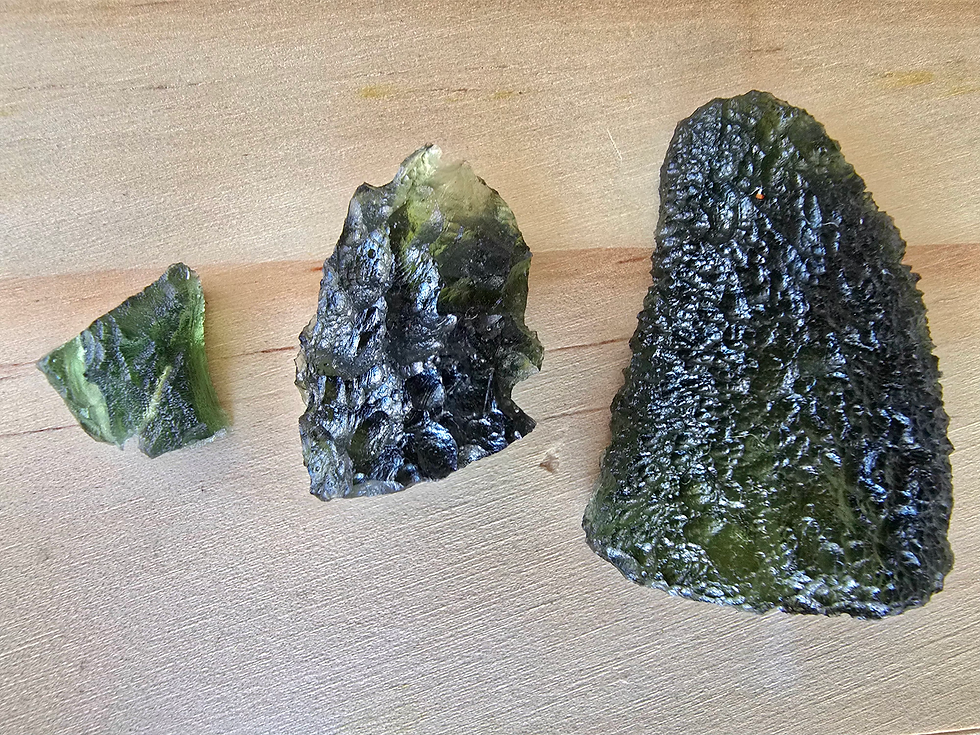
Some pieces are lighter green and glassy. Some are deep forest green. Some look almost black until sunlight passes through them. Some are smooth and soft in shape. Others are sharp, detailed or deeply textured.
That’s part of what makes choosing one feel personal.
No two pieces came out exactly the same.

Should your first Moldavite be small or large?
For most people, a smaller piece is enough to start with.
You don’t need a huge Moldavite for it to feel meaningful. A piece under 3g can still be genuine, beautiful and easy to connect with. It’s also a more comfortable starting point if you’re new to Moldavite or you’re not sure what kind of piece you want yet.
Smaller pieces are good if you want something simple, affordable and easy to carry. They’re also a good choice if you want to place one somewhere personal, keep it in a pouch or start slowly without spending too much.
The 3g to 6g range is a nice middle ground. These pieces usually have more presence in the hand, more visible surface detail and more shape to appreciate. They still feel practical, but they don’t feel too tiny.
The 6g to 10g range starts to feel more substantial. These are better if you already know you want something with stronger visual presence or you’re choosing a piece to keep long term.
Once you go over 10g, you’re moving more into collector territory. Larger Moldavites can be incredible, especially when the shape, texture and condition are strong. But they’re not necessary for a first piece.
If a larger one genuinely keeps pulling your attention and the price feels right, that’s different. Just don’t buy a bigger piece because you think you’re supposed to.
You’re not.
Raw Moldavite or Moldavite jewellery?
Raw Moldavite is best if you want the piece in its natural form.
You can see the surface, the shape, the texture and the way it formed. There’s something honest about holding the piece as it is. Raw pieces are also easier to compare because you can look directly at weight, condition, locality and natural detail.
Jewellery is better if you want to wear Moldavite often. A pendant is usually the easiest choice because it sits close to the body and doesn’t get knocked around as much as a ring. Rings can be beautiful, but they’re more exposed to damage because your hands are always moving, touching things and getting bumped.
Neither choice is better for everyone.
If you want something natural and untouched, choose raw.
If you want something you can keep close throughout the day, jewellery probably makes more sense.

Does the shape matter?
Shape matters, but not in a strict rule based way.
Some people love long drop shaped pieces. Some prefer chunky pieces with more weight and depth. Some like thin flat pieces because they’re easy to carry or wear. Others feel drawn to heavily textured pieces because they look more alive in the light.
Besednice Moldavite is known for its detailed, often spiky surface texture. Other Moldavites can be smoother, rounder, layered or more simple in shape. None of this makes one piece better for everyone.
It just changes the feeling of the piece.
This is where I think people can get too logical. They try to choose the “best” shape, but Moldavite doesn’t really work that way. A perfect looking piece might not feel personal to you. A simple darker piece might be the one you keep thinking about.
The better move is to slow down.
Don’t rush through every photo like you’re comparing normal products. Look properly. Notice which one holds your attention a little longer. Notice which one you open again after leaving the page.
That usually tells you something.
Does colour matter?
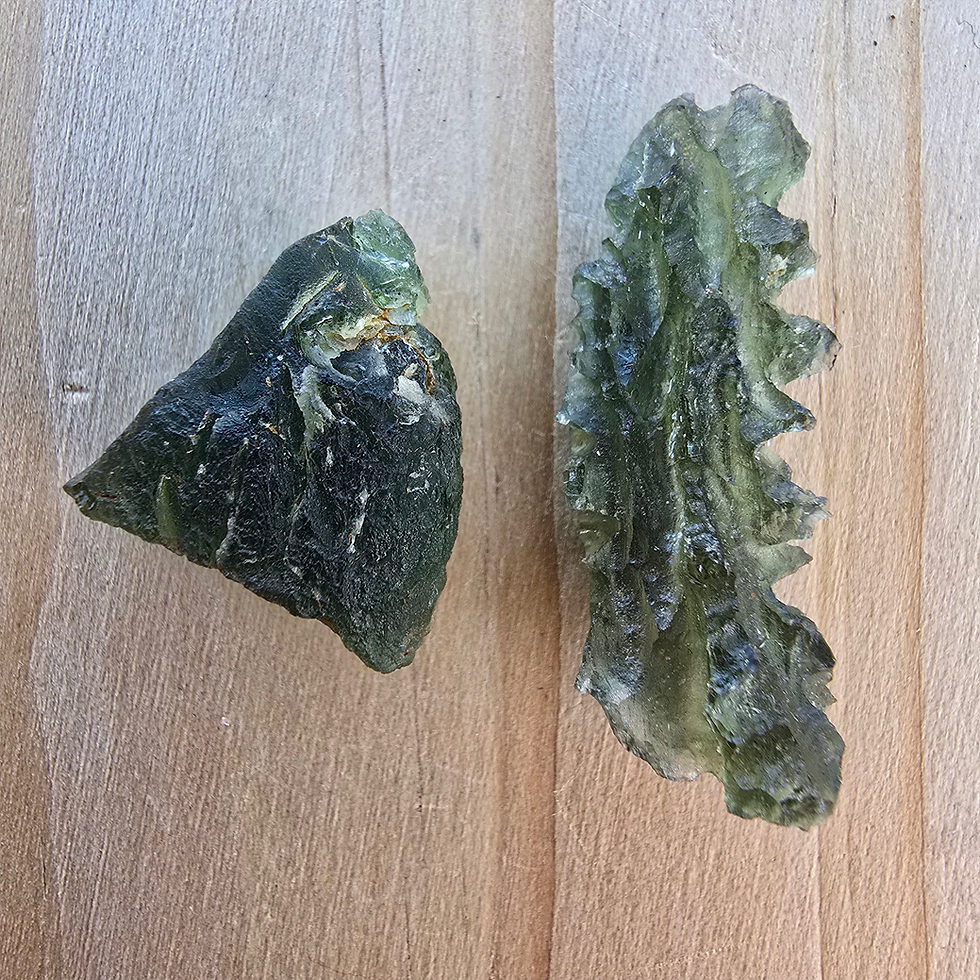
Moldavite can range from lighter green to olive green, forest green and very dark green. Some pieces look almost black in normal lighting, then show a deep green glow when sunlight hits them.
That doesn’t mean the darker piece is worse.
It also doesn’t mean the brighter one is automatically better.
A lot depends on thickness, structure and lighting. Thinner pieces often let light through more easily. Thicker pieces can look darker because the light has more glass to pass through.
This is why photos matter so much when buying online.
You want clear photos of the exact piece. Not stock images. Not a random example. Not over edited photos that make every piece look brighter than it really is.
You want to see what you’re actually buying.

What about chips or damage?
A small chip doesn’t always ruin a Moldavite.
These pieces have been dug up, sorted, handled and moved around. Some edge wear can happen. The real issue is whether the condition is shown clearly and priced fairly.
A clean intact piece will usually be worth more than a damaged one of similar size and quality. That’s normal.
But a chipped piece can still be genuine, beautiful and meaningful. It just shouldn’t be hidden. It also shouldn’t be priced like a perfect collector piece if the damage is obvious.
That’s where trust matters.
If the seller is vague about condition, be careful. If the photos hide the edges or only show one flattering angle, be careful. If a listing says very little and the price seems strangely low, there’s usually a reason.
With Moldavite, honest presentation matters more than perfect presentation.

How much should you spend on your first Moldavite?
Spend what feels comfortable. That’s the honest answer.
Don’t stretch yourself into a piece that makes you feel stressed after buying it. A smaller genuine Moldavite is a much better first choice than a larger piece you feel unsure about.
Price depends on weight, condition, texture, colour, locality, rarity and how the piece is set if it’s jewellery. A highly textured locality piece will often cost more than a simple fragment. A silver pendant will cost more than the Moldavite alone because the setting and workmanship are part of it too.
The best first piece is one that feels right, is clearly genuine, is priced fairly and doesn’t leave you second guessing yourself.
If the price feels uncomfortable, step down in size. There’s nothing wrong with starting smaller.
What should you check before buying Moldavite?
Look for exact piece photos. You should be able to see the actual Moldavite you’re buying, not a general example.
Check the exact weight. Weight matters with Moldavite, so it should be clear.
Look for natural light photos or videos where possible. This helps show the real colour and texture.
Read the condition notes. Chips, damage or repairs should be mentioned clearly.
Check the return policy. A clear return policy gives you more confidence.
Be careful with listings that feel too cheap, too vague or too perfect. Genuine Moldavite has become harder to source, so if something looks strangely cheap for a clean piece, pause before buying.
A trustworthy listing should make you feel clearer, not more confused.
What if you don’t feel anything from Moldavite?
That’s completely normal.
Some people feel heat, tingling, emotion, pressure or a sudden shift when they hold Moldavite. Other people don’t feel much at all at first.
That doesn’t mean the piece is wrong. It doesn’t mean you chose badly. It doesn’t mean it’s fake.
Not every connection has to be dramatic.
Sometimes it’s subtle. Sometimes it builds slowly. Sometimes the piece is simply something ancient and beautiful that reminds you of change, intention and presence.
I wouldn’t buy Moldavite because someone promised it would change your life overnight. That kind of hype helps no one.
Choose it because you feel genuinely drawn to it. Choose it because you trust where it’s coming from. Choose it because something about that exact piece feels worth keeping close.
So which Moldavite should you choose first?
If you’re completely new to Moldavite, I’d keep it simple. Start with a smaller raw piece or a simple pendant. If you want something with more presence, look around the 3g to 6g range. If a larger piece genuinely keeps catching your attention, that’s fine too, but don’t choose one just because it feels more impressive.
The best first piece is usually the one you keep coming back to. Not the biggest one. Not the most expensive one. The one that makes you stop for a second.
Where to start
If you want a gentle first piece, start with smaller Moldavites under 3g.
If you want something with more presence, look through the 3 to 6g Moldavites.
If you want something more substantial without going too large, explore the 6 to 10g Moldavites.
If you want a larger collector piece, look through the 10 to 20g Moldavites or the 20g plus Moldavites.
If you want to wear it daily, Moldavite jewellery is usually the most practical choice.
If you’re unsure and just want to browse everything, start with the full Moldavite collection.
Moldavite isn’t something you need to force. The right piece usually makes you pause.
Frequently asked questions
Is a small Moldavite still worth buying?
Yes. A small Moldavite can still be genuine, meaningful and beautiful. You don’t need a large piece for it to matter. Smaller pieces are often the best place to start because they’re easier to carry, more affordable and less intimidating if you’re new to Moldavite.
Is raw Moldavite better than jewellery?
Raw Moldavite is better if you want the piece in its natural form and want to hold it directly. Jewellery is better if you want to wear it often and keep it close during the day. Neither is better for everyone. It depends on how you want to use it.
What size Moldavite should I start with?
Most people are fine starting under 3g or around 3g to 6g. If you want something gentle and affordable, start smaller. If you want more presence in the hand, go a little larger. You don’t need a 10g plus piece for your first Moldavite unless you genuinely feel drawn to one.
Does darker Moldavite mean lower quality?
No. Darker Moldavite isn’t automatically lower quality. Some pieces look very dark because they’re thicker or denser, then show deep green when light passes through them. Colour should be judged with lighting, thickness, condition and overall character in mind.
What if I don’t feel anything from Moldavite?
That’s normal. Some people feel Moldavite strongly straight away. Others don’t. It doesn’t mean the piece is fake or wrong for you. Sometimes the connection is subtle. Sometimes it takes time. Sometimes the value is simply in having a genuine piece that you feel drawn to.
How do I know if Moldavite is genuine?
Look for exact piece photos, exact weight, clear texture, honest condition notes and a seller who explains what you’re actually buying. Be careful with stock photos, vague listings, prices that seem too cheap and pieces that look overly perfect. Genuine Moldavite has natural variation, so the listing should show the actual piece clearly.
Comments