What Is Moldavite? Rare Green Tektite and Impact Glass
Moldavite is a rare green tektite, which means it’s a natural impact glass formed during a meteorite impact. It’s not the meteorite itself. It’s not man made glass. It’s not crystalline in the mineral sense. Moldavite formed from terrestrial surface sediments that were melted, ejected through the air, then cooled into natural glass after the Ries impact in what’s now southern Germany around 14.75 million years ago.
That simple answer matters because Moldavite gets described badly online all the time. Some people call it a meteorite. Some call it a crystal. Some make it sound like it came directly from space. The more accurate answer is more interesting than that.
Moldavite came from Earth, but it was created by a cosmic event. That’s what makes genuine Moldavite so different from ordinary green glass, volcanic glass or most other natural materials people collect and wear.
So what exactly is Moldavite?
The cleanest way to explain Moldavite is this.
Moldavite is natural green impact glass from the tektite family. Tektites are natural glasses formed when meteorite impacts melt Earth material and throw it through the air. That material cools quickly, then lands across what’s called a strewn field.
So Moldavite isn’t a piece of the meteorite. It’s not outer space rock. It’s Earth material transformed by impact, heat, pressure, flight and cooling.
That’s the real story behind it.
It has a scientific origin, a known age, a limited natural source area and a look that’s hard to fake properly when you understand the details.
How Moldavite formed
The simple version is that a meteorite hit Earth, melted surface material, then threw that material through the air where it cooled into glass.
The deeper version is more intense.
The Institute of Geology of the Czech Academy of Sciences explains that Moldavites are generally understood to have formed from superficial Tertiary sediments in the Ries area during a meteorite impact around 15 million years ago. Material from the impact was ejected at extreme speed, shaped by heat and pressure, then deposited mostly in what’s now the Czech Republic.

That process helps explain why genuine Moldavite can show such strong variation in shape, colour, thickness, surface texture, bubbles and internal structure.
No two genuine pieces come out exactly the same because they weren’t manufactured. They were formed through chaos.
Where Moldavite comes from
Most of the Moldavite people know and collect comes from the Czech Republic, especially South Bohemia and Moravia. That’s why Czech Moldavite is what most people are referring to when they talk about genuine Moldavite.
The wider Moldavite strewn field is more nuanced than that. Mindat lists Moldavite as being found mainly in southern Bohemia and Moravia, with minor occurrences in Austria and Germany. Very rare occurrences have also been reported from south west Poland.
For buyers, Czech Moldavite is the main material you’ll usually see on the market.
Where the name Moldavite came from
The name Moldavite is often explained as coming from the Moldau River, also known as the Vltava River. That’s close, but the more complete version is tied to actual recorded localities.
Mindat notes that the name was introduced after the main occurrence at the Vltava River in Southern Bohemia. It also lists the first recorded locality as the Moldavite occurrence near Týn nad Vltavou in the České Budějovice District of the South Bohemian Region.
That keeps the story grounded. Moldavite isn’t just a romantic name. It’s tied to real places in the Czech landscape.
What Moldavite looks like
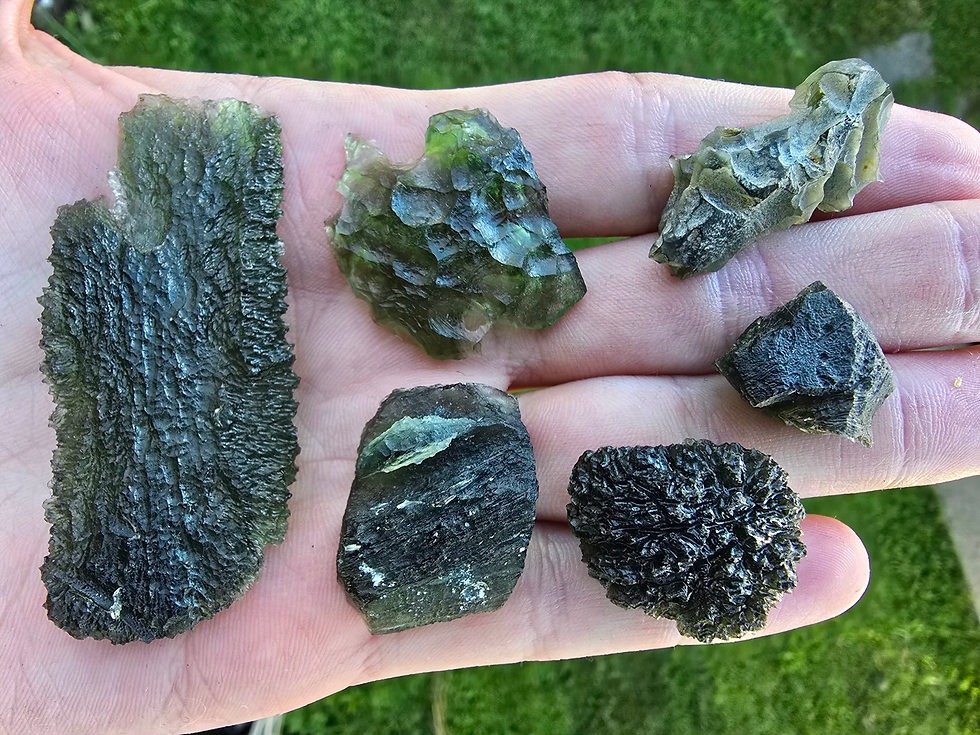
Moldavite is usually green, but the exact colour can vary. It may appear forest green, olive green, bottle green, brownish green or lighter green depending on the piece, thickness and lighting.
Raw Moldavite often has a naturally sculpted surface. Some pieces show deep grooves, pitting, wrinkles, channels, folds, sharp ridges or etched texture. Others are smoother or more worn. Some are thin and translucent. Others are darker because they’re thicker.
This variation is part of what makes genuine Moldavite so interesting. Real pieces don’t all look the same. The shape, texture, tone and feeling can shift dramatically from one piece to another.

Why Moldavite has bubbles, flow lines and internal features
Moldavite is natural glass, so internal features can be part of its character. Genuine pieces may show bubbles, flow lines, schlieren and lechatelierite. These features can help support identification when they appear alongside the right surface texture, colour, shape and seller transparency.
That doesn’t mean every visible bubble proves a piece is real. Fake glass can contain bubbles too. Bubbles are only one part of the picture.
The full judgement should include surface texture, shape, colour, internal structure, weight, photos, seller transparency and whether the piece looks naturally formed rather than manufactured.

Is Moldavite rare?
Yes, Moldavite is naturally limited because it formed from one ancient impact event and only occurs within a limited strewn field.
That doesn’t mean every piece is equally rare. Small common shapes, damaged pieces, jewellery grade pieces, collector localities and highly sculpted specimens can all sit in different value ranges.
Rarity depends on more than the word Moldavite. Size, condition, locality, texture, shape, colour, clarity and overall character all matter.
If you want a deeper breakdown of Moldavite price, I’ve covered that separately in the Moldavite price guide.
Is Moldavite crystalline?
No, Moldavite isn’t crystalline in the scientific sense.
Crystalline materials have an ordered internal structure. Moldavite is natural glass, which means it’s amorphous rather than crystalline. It can still be used, worn and appreciated in spiritual spaces, but scientifically it belongs to the tektite family.
This distinction matters because accurate language builds trust. Calling Moldavite a crystal may be common in spiritual communities, but it’s not the most accurate way to describe what it actually is.
A better way to describe it is: Moldavite is a rare green tektite and natural impact glass.
Is Moldavite a meteorite?
No, Moldavite isn’t a meteorite.
A meteorite is material from space that survives its fall to Earth. Moldavite formed from Earth material that was melted and ejected during a meteorite impact. The meteorite impact caused Moldavite to form, but Moldavite itself is not the meteorite.
That’s an important difference.
The story is still cosmic, but it’s not because Moldavite is a piece of the meteorite. It’s because Moldavite was created by the collision between space and Earth.
Why people are so drawn to Moldavite
Part of the attraction is visual. Moldavite has a look that feels alive when you study it closely. The texture, colour, shape and internal character can make every piece feel individual.
Part of the attraction is geological. It formed through impact, heat, pressure, movement and cooling. That alone makes it one of the most interesting natural glasses people can own.
Part of the attraction is personal. Many people connect with Moldavite because of what it represents. Change. Transformation. Pressure becoming beauty. Something earthly touched by something cosmic.
That side is personal, so it shouldn’t be overstated. Some people feel a strong connection with Moldavite. Some don’t. The real story is already powerful enough without exaggerating it.
What makes genuine Moldavite different from fake green glass?
A fake can be green. A fake can look interesting in a photo. A fake can even have bubbles. That doesn’t make it Moldavite.
Genuine Moldavite tends to show a more natural combination of surface texture, internal character, irregular shape, believable colour and geological context. Fakes often look too smooth, too glossy, too rounded, too repeated or too much like they came from the same mould.
Seller transparency matters here. You should be able to see the exact piece, exact weight, clear photos and honest product details. If a seller relies only on hype, vague claims or blurry photos, slow down.
If you want a deeper guide on how to tell if Moldavite is real, I’ve covered the practical signs in a separate authenticity guide.
Why no two Moldavite pieces are the same
Every genuine Moldavite piece has its own character. Some are sharp and sculpted. Some are smoother and naturally worn. Some are small and delicate. Some are thick and dark. Some are bright in sunlight. Some carry deeper olive or forest green tones.
This is part of the reason people often choose a specific piece rather than just buying any Moldavite.
When you’re choosing Moldavite, you’re not only choosing the material. You’re choosing the exact shape, texture, weight, tone and feeling of one individual piece.
FAQ
What is Moldavite made of?
Moldavite is natural impact glass formed from terrestrial surface sediments melted during the Ries meteorite impact. It’s part of the tektite family.
How old is Moldavite?
Moldavite formed around 15 million years ago during the Ries impact event in what’s now southern Germany.
Where is Moldavite found?
Most Moldavite comes from the Czech Republic, especially South Bohemia and Moravia. Minor occurrences are also known from Austria and Germany, with very rare reported material from south west Poland.
Is Moldavite from space?
Not directly. Moldavite formed because of a meteorite impact, but the material itself came from Earth. It’s more accurate to say Moldavite was created by a cosmic impact event.
Is Moldavite natural glass?
Yes. Moldavite is natural impact glass, not ordinary manufactured glass.
Why is Moldavite green?
Moldavite’s green colour comes from its natural chemistry and formation conditions. The exact tone can vary from lighter green to deep olive or forest green.
Can Moldavite be fake?
Yes. Fake Moldavite is common. That’s why clear photos, exact weights, surface texture, internal features and seller transparency matter so much.
About the author
This guide was written by Nathan Harris, founder of Conscious Creators, a New Zealand based store focused on genuine Moldavite, tektites and impact glass. Nathan has handled, photographed and listed genuine Moldavite pieces through Conscious Creators, with a focus on clear product photos, exact weights, honest descriptions and grounded education. The aim is to help people understand what Moldavite actually is so they can choose a piece with both confidence and personal connection.

Browse genuine Moldavite
If you feel ready to choose a piece, you can view the current Moldavite collection here. Each listing shows the exact piece, exact weight and clear photos so you can choose the one that genuinely feels right.
Sources referenced
Institute of Geology of the Czech Academy of Sciences: Moldavite formation and the Ries impact.
Mindat: Moldavite locality information
GIA Gems & Gemology: Moldavites: Natural or Fake? by Jaroslav Hyršl, Spring 2015, Volume 51, Number 1, pages 103 to 104.
Comments