Libyan Desert Glass: Formation Origin and Meaning
Updated: May 18
Libyan Desert Glass formed around twenty eight million years ago in what is now the Great Sand Sea, a vast desert region stretching between western Egypt and eastern Libya. Long before humans existed, before the Sahara became what it is today, this glass was born from a single, extraordinary moment.
Most scientists agree its origin is tied to a powerful cosmic event. A meteor entered Earth’s atmosphere over the desert and released an immense amount of heat. That heat was intense enough to melt the surface sand almost instantly. The sand, rich in silica, liquefied in place. The molten material was then blasted upward, cooled as it moved through the air, and fell back to the ground as natural glass, scattered across the desert floor.
Temperatures during this event are estimated to have exceeded sixteen hundred degrees Celsius. That is hotter than any volcanic process on Earth. This alone separates Libyan Desert Glass from volcanic glass and places it firmly in the category of impact glass.
One of the most intriguing aspects of Libyan Desert Glass is that no confirmed crater has ever been found. This has led to ongoing scientific discussion. Some researchers believe the event was an airburst, similar to the Tunguska explosion in Siberia, where the incoming body detonated above the surface without leaving a crater. Others believe there was a direct impact, but that any crater was slowly erased by millions of years of wind erosion and shifting desert sands. At this point, both explanations remain possible.
What is clear is that the energy involved was extreme and far outside normal Earth processes.
Libyan Desert Glass is composed of approximately ninety eight percent silica, making it one of the purest natural glasses found on Earth. It also contains small amounts of minerals such as zircon, cristobalite, and lechatelierite. Under microscopic examination, scientists have identified reidite, a high pressure form of zircon. Reidite only forms under the intense shock pressures created during meteor impacts. Its presence is one of the strongest pieces of evidence confirming Libyan Desert Glass as true impact glass rather than volcanic in origin.

The glass itself varies in appearance. Colours range from pale yellow to rich gold, sometimes showing soft green tones depending on internal chemistry. Some pieces are exceptionally clear, while others contain tiny bubbles, flow lines, and subtle internal textures formed as the molten glass cooled while moving through the air. Over millions of years, desert winds carrying fine sand have shaped the surface, smoothing edges and creating the textures seen today. No two pieces are the same.
Libyan Desert Glass has been known to humans for thousands of years. The most famous historical example is the carved scarab set into the breastplate of Pharaoh Tutankhamun, made entirely from this glass. This shows that ancient cultures recognised its rarity and importance long before its scientific origin was understood. It was valued not just as a material, but as something special.
Today, Libyan Desert Glass is significant for several reasons. Scientifically, it preserves direct evidence of a high energy impact event and helps researchers understand how extreme heat and pressure affect Earth materials. Geologically, it represents a rare and well preserved example of natural glass formed outside volcanic systems. Historically, it connects modern study with ancient human use and reverence.
Beyond all of that, Libyan Desert Glass stands as a record of transformation. Ordinary Earth material exposed to overwhelming force, then cooled into something clear, stable, and enduring. It shows how intensity does not always lead to destruction. Sometimes it leads to creation.
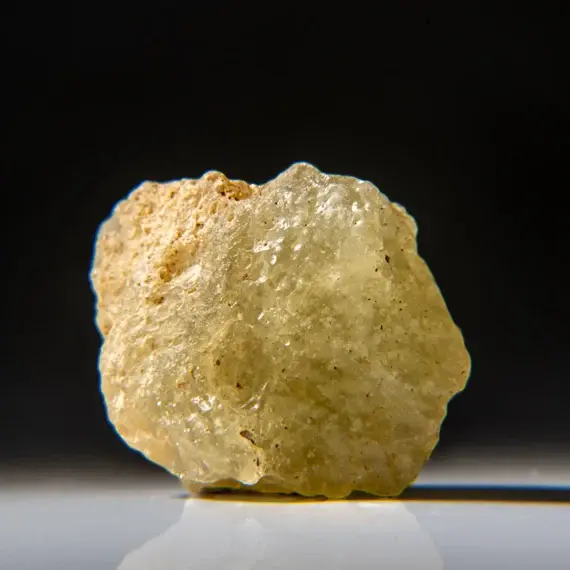
Each piece of Libyan Desert Glass is millions of years old and completely unique. It is Earth material shaped by a single cosmic moment, then refined by desert wind and time. That depth of origin, combined with its purity and history, is what gives Libyan Desert Glass its lasting significance today.
Comments